



Since ChatGPT launched in late 2022, it has captivated millions with its conversational answers to virtually any question. However, it lacked one critical element: real-time information. In response, the AI search engine landscape exploded, with major players like Google and Bing integrating generative AI to offer real-time, conversational answers directly within search results. New competitors, including Perplexity AI, You.com, and Brave Search, quickly emerged, building tools to meet the demand for AI-enhanced search.
This guide explores the best AI search engines available in 2024, comparing their key features, pros, cons, and ideal use cases to help you find the right tool.
Perplexity AI: Best AI Search Engine for Conversational Search
Pros:
- User-friendly, conversational interface with organized search threads.
- Built-in prompt suggestions for current events.
- Detailed AI-generated answers with footnotes and links.
Cons:
- Struggles with ongoing events.
- Limited access to advanced features without a subscription.
Overview:
Unlike traditional search engines retrofitted with AI, Perplexity AI was built from the ground up as an AI search engine. It combines the best aspects of chatbot-style interaction with search functionality, providing users with answers that are conversational and often cited. This makes it a powerful tool for those looking for structured information without diving into multiple links. When you begin typing a question, Perplexity even suggests prompts based on trending topics, helping users discover new ideas effortlessly.

In addition to its conversational responses, Perplexity offers related questions similar to Google’s “People also ask” feature, helping you dig deeper into topics. This is ideal for research-focused users who want AI-assisted discovery and insight in a single interface.
Pricing:
Free version available; premium plan at $20/month for advanced models (GPT-4 Turbo, Claude 3) and features.ChatGPT Search: Best for a Chatbot-Style Search Experience
Pros:
- Fully integrated with ChatGPT’s interface.
- Automatic or manual web-calling for real-time answers.
- Simple to use with natural language processing.
Cons:
- Requires a ChatGPT Plus subscription ($20/month).
- Limited web access for free users until future updates.
Overview:
ChatGPT has also evolved into a search tool, with the addition of a web-browsing feature that allows users to tap into real-time information. For those who love ChatGPT’s interface, this upgrade maintains the platform’s hallmark speed, accuracy, and ease of use, making it a natural fit for those who prefer chat-based search interactions.
When activated, ChatGPT Search doesn’t just answer your questions but processes them with enhanced natural language understanding. This lets users ask questions in a more conversational manner, reducing the need to rephrase complex thoughts. While a Plus subscription is currently required for this feature, OpenAI plans to expand web access to free users in the coming months.
Pricing:
$20 per month for ChatGPT Plus; includes benefits like voice mode, image generation, and canvas capabilities.
Microsoft Bing (with Copilot): Best AI Search Engine for Seamless AI Integration
Pros:
- GPT-4-powered Copilot integration.
- High-quality, non-intrusive AI insights that stay to the side.
- Free to use, ideal for those new to AI search.
Cons:
- Limited to Bing’s search engine ecosystem.
- AI insights may sometimes be overly simplified.
Overview:
Microsoft’s Bing has effectively combined AI and search with its Copilot integration, which uses OpenAI’s GPT-4 to provide accurate, up-to-date answers. Copilot has helped Bing attract millions of new users, thanks to its non-overbearing design, where AI summaries appear in a side box without overwhelming the standard results. This approach is perfect for those who want to explore AI-enabled insights while maintaining the traditional search format.
The AI insights box can be expanded for deeper information, making it easy to toggle between AI-powered insights and standard search results. Copilot in Bing is ideal for users who want to test AI search without fully committing to a separate AI-only search engine.
Pricing:
Free to access.
Google Search Generative Experience (SGE): Best for Loyal Google Users
Pros:
- Google-powered, accurate, and authoritative summaries.
- Option to access the Gemini chatbot for more in-depth responses.
- Integrates seamlessly into Google’s interface.
Cons:
- Takes up significant space on the results page.
- Limited AI response customization options.
Overview:
For loyal Google users, the Search Generative Experience (SGE) is a natural step forward. Google SGE incorporates AI summaries at the top of search results for queries where AI can add value, like fact-based inquiries. Unlike some other AI search tools, SGE keeps standard search options available below the AI insights, allowing users to verify and explore more deeply.
With its Gemini chatbot, Google’s AI search also enables conversational interactions. The AI summaries are highly authoritative but can occupy much of the screen’s top portion, which may be a drawback for users who prefer traditional search layouts.
Pricing:
Free; Gemini Advanced available for $19.99/month for additional features.
You.com: Best AI Search Engine with Custom Model Selector
Pros:
- Customizable with various LLMs, including GPT-4 Turbo and Claude.
- Privacy-focused mode available, similar to incognito.
- Provides a “People also ask” section for enhanced discovery.
Cons:
- Less traditional search layout may not suit all users.
- Premium model selector requires a subscription.
Overview:
You.com offers a blend of search engine and chatbot functionalities with the ability to toggle between different language models. This makes it versatile for those seeking personalized results, as you can select from leading models based on your needs. You.com provides footnotes in its responses, so you can verify sources directly, and includes a “People also ask” section for expanded exploration.
With its user-controlled model selector, You.com is ideal for users who want flexibility in their AI responses and more control over which models generate their answers.
Pricing:
Free version; premium subscription available for model upgrades.
Brave Search: Best AI Search Engine for Privacy-Conscious Users
Pros:
- Emphasis on privacy and ad-blocking features.
- AI insights without tracking or data-sharing.
- Uses Brave’s independent search index.
Cons:
- Lacks footnotes for AI-generated answers.
- Limited information for high-profile events.
Overview:
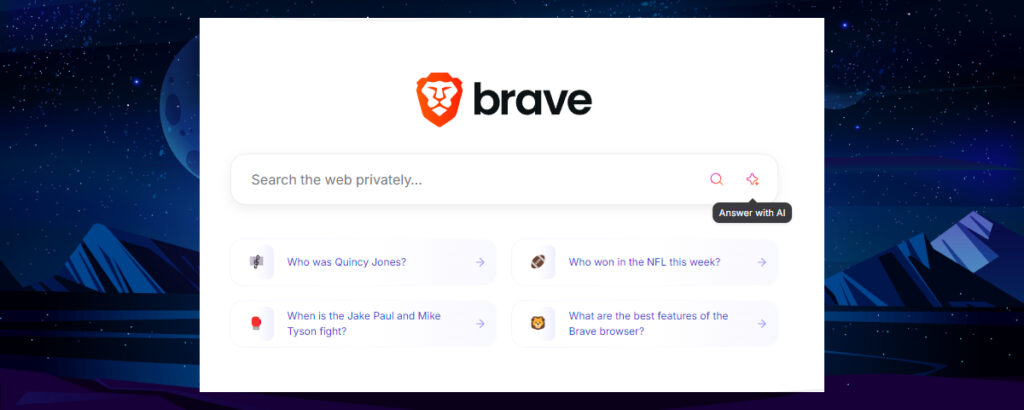
For those prioritizing privacy, Brave Search integrates AI while maintaining security features such as ad-blocking and tracker prevention. Brave recently added an “Answer with AI” feature that provides responses similar to those from Google or Bing but without sacrificing privacy. Brave’s answers, although less detailed, are reliable for general information without relying on Google or Bing’s indexes.
Pricing:
Free; available with Brave’s independent search index.
Choosing the Best AI Search Engine for Your Needs
Each AI search engine brings something unique to the table. Here’s a quick guide to help you choose:
- For conversational research: Choose Perplexity AI.
- For a chatbot-style experience with web access: ChatGPT Search is ideal.
- For traditional search with integrated AI: Microsoft Bing with Copilot.
- For Google users wanting AI insights: Try Google SGE.
- For customizable AI models: You.com offers variety.
- For privacy-focused users: Brave Search is the best option.
Testing AI Search Engines with Python
To further explore and evaluate the capabilities of various AI search engines, we’ve included a Python script below that can query multiple AI-powered tools and save the responses to a CSV file for easy comparison. This script can be a helpful resource for developers, researchers, and tech enthusiasts who want to validate and analyze the outputs of AI search engines like ChatGPT, Google Bard, and Perplexity AI.
Python Script: AI Search Output Tester
The following script allows you to send predefined queries to multiple AI search engines and record their responses in a CSV file. Each response is stored along with the tool’s name, the query, and a timestamp. This structure allows for easy analysis of how each tool interprets and answers different types of questions.
import requests
import csv
import datetime

# Define your API endpoints and keys for the AI tools
API_DETAILS = {
    'ChatGPT': {'API_ENDPOINT': 'https://api.openai.com/v1/engines/chatgpt/completions', 'API_KEY': 'your_chatgpt_api_key'},
    'Google Bard': {'API_ENDPOINT': 'https://api.google.com/bard', 'API_KEY': 'your_google_bard_api_key'},
    'Perplexity AI': {'API_ENDPOINT': 'https://api.perplexity.ai/query', 'API_KEY': 'your_perplexity_api_key'}
}

# Function to get AI response
def get_ai_response(tool_name, query):
    api_info = API_DETAILS[tool_name]
    headers = {"Authorization": f"Bearer {api_info['API_KEY']}"}
    data = {"prompt": query, "max_tokens": 100}  # Modify as per tool's API requirements
    response = requests.post(api_info['API_ENDPOINT'], headers=headers, json=data)

    if response.status_code == 200:
        return response.json().get('choices', [{}])[0].get('text', 'No response')
    else:
        return f"Error {response.status_code}: {response.text}"

# Test queries
queries = ["What is the best AI search engine?", "How does AI improve search results?"]

# Write responses to CSV
with open('ai_search_outputs.csv', mode='w', newline='', encoding='utf-8') as file:
    writer = csv.writer(file)
    writer.writerow(['Tool', 'Query', 'Response', 'Date'])

    for tool in API_DETAILS.keys():
        for query in queries:
            response = get_ai_response(tool, query)
            writer.writerow([tool, query, response, datetime.datetime.now().isoformat()])

print("Responses saved to ai_search_outputs.csv")
How the Script Works
- Setup API Details: The script defines API endpoints and API keys for each AI search engine, such as ChatGPT, Google Bard, and Perplexity AI.
- Get AI Response: The function
get_ai_response()sends a request to the specified tool’s API with a given query. If the response is successful, it extracts the AI-generated text; otherwise, it returns an error message. - Define Queries: A list of test queries, such as “What is the best AI search engine?” is provided to compare responses from each AI tool.
- Save Results to CSV: Each response is recorded in a CSV file (
ai_search_outputs.csv) along with the tool’s name, query, response, and timestamp.
How This Script Can Help You
By running this script, you can:
- Compare Accuracy: Review how each AI tool answers the same query to understand differences in accuracy and depth.
- Evaluate Relevance: Check if the responses are relevant, timely, and factually correct.
- Monitor Consistency: Test multiple queries over time to see if the responses remain consistent, especially with tools updated in real-time.
This automated approach offers a streamlined way to validate the capabilities of different AI search engines, providing you with data-driven insights to choose the best tool for your needs.
Final Thoughts on AI Search in 2024
AI search engines are reshaping how we find information online, making the process faster and more intuitive. Although each tool has its strengths and limitations, they represent a step toward a future where search becomes more conversational, accurate, and relevant.
With AI technology advancing rapidly, it’s likely these tools will only become more powerful, offering users an increasingly seamless blend of AI and search. For now, whether you need the best AI chatbot integration, privacy-focused search, or flexible AI models, there’s a perfect AI search engine waiting for you.
FAQ: Understanding and Choosing AI Search Engines in 2024
What is an AI search engine?
An AI search engine uses generative AI technology to deliver direct answers to user queries by synthesizing information from multiple sources, often with conversational responses. Unlike traditional search engines that provide a list of links, AI search engines aim to deliver answers upfront, saving users time.
How is an AI search engine different from an AI chatbot?
An AI search engine is connected to the internet and designed to pull real-time, accurate information from web sources, presenting results similarly to traditional search but with AI enhancements. An AI chatbot, like ChatGPT, is often limited to pre-existing knowledge and may lack current internet access, providing conversational responses based on its training data.
Do I need to pay to use AI search engines?
Most AI search engines, like Google SGE, Microsoft Bing, Brave Search, and the basic version of Perplexity AI, are free. However, some, like ChatGPT’s web-browsing feature or Perplexity Pro, offer premium subscriptions for advanced features and models.
Which AI search engine is best for real-time information?
Google SGE and Microsoft Bing are highly recommended for real-time, up-to-date information. They’re designed to blend traditional search with AI summaries, making them ideal for fact-based queries and timely events.
Is Perplexity AI better than ChatGPT for search?
Perplexity AI is specifically designed as an AI search engine, offering web-based, conversational responses and search-oriented features like follow-up prompts and related questions. ChatGPT Search provides a similar experience within the ChatGPT interface but requires a Plus subscription. If your priority is search rather than conversation, Perplexity may be more suitable.
What’s the best AI search engine for privacy?
Brave Search is the top choice for privacy-conscious users. It blocks trackers and ads, relies on its own search index, and includes an “Answer with AI” feature without sharing user data with third parties.
Can AI search engines replace traditional search engines?
AI search engines complement traditional search engines by offering quicker, more direct answers. However, for certain searches—like in-depth research or browsing diverse sources—traditional engines still provide value. Many AI search engines, like Google SGE and Bing with Copilot, allow users to switch between AI and traditional search modes, offering a blended experience.
Which AI search engine is best for mobile users?
Arc Search is particularly optimized for mobile, with features like the “Browse for Me” option that organizes search information into structured reports. This makes it easier to digest information on smaller screens, especially for users who need comprehensive data quickly.
Can I choose which language model (LLM) an AI search engine uses?
Yes, You.com allows users to toggle between various leading LLMs, such as GPT-4 Turbo and Claude. This flexibility lets users select the model best suited to their needs, which is unique among AI search engines.
How reliable is the information provided by AI search engines?
While AI search engines strive to be accurate, there can still be issues with reliability and sourcing. It’s recommended to cross-check important information, as some AI tools may pull from sources of varying credibility. For critical information, Google SGE and Microsoft Bing provide authoritative results with a backup of traditional search options.
How are AI search engines expected to evolve?
AI search engines are likely to become more advanced, incorporating improved models, more accurate sourcing, and a better understanding of user intent. As they evolve, they may further streamline search by providing increasingly accurate, real-time answers directly within search platforms, minimizing the need to sift through multiple sources manually.